✍️ DAY SIX – Travel Day (Pegasus + Munich stop)
Today was a travel day, involving another experience with a budget airline I hadn’t used before — Pegasus.
To be honest, my biggest concern was not having an entry stamp in my passport. In the end, I really shouldn’t have wasted time worrying. Security and passport control were among the smoothest I’ve experienced recently, and no one even seemed to notice the missing stamp.
💡 Traveller Tip
Yesterday’s lunch, away from the tourist areas, cost me 450 TL (around €10). A coffee and dessert at the Holiday Inn cost 380 TL, and a small can of Sprite with biscuits on the flight cost 384 TL.
The lesson is simple: eat and drink away from tourist areas and hotels whenever possible — the mark-up is significant.
 |
| Beer!!! Ian Thompson, 5/5/25 |
 |
| Insider Augustiner Stammer, Ian Thompson, 5/5/25 |
 |
| Bavarian Dinner, Ian Thompson 5/5/25 |
I had a fantastic Bavarian dinner of sausages, sauerkraut, pretzel, and beer at Augustiner Stammhaus, one of the oldest breweries in Munich. While the building itself is not the original, this site has been associated with brewing for centuries.
🏛 Kongresshalle (Documentation Centre)
My first stop was Kongresshalle.
The Kongresshalle (Congress Hall) in Nuremberg is one of the most striking examples of Nazi-era architecture. Built between 1935 and 1939 as part of the Nazi Party Rally Grounds, it was designed for massive party congresses but was never completed.
Inspired by the Roman Colosseum, its vast brick structure reflects the regime’s obsession with scale and permanence. Today, it houses the Documentation Centre, which presents powerful exhibitions on the history of the Nazi regime. The site remains both a warning from history and a place of reflection.
 |
| Inside Kongresshall, Nuremburg, Ian Thompson 7/5/25 |
 |
| Me at Kongresshall, Nuremburg, Ian Thompson, 7/5/25 |
🚶♂️ Zeppelin Field
Leaving Kongresshalle, I walked down the former processional road made up of over 60,000 stone slabs, aligned with Nuremberg Castle as intended by Albert Speer.
I then continued to the Zeppelin Field.
The Zeppelin Field was designed to hold up to 200,000 people and served as the stage for Nazi propaganda rallies led by Hitler. Its grandstand still stands today, partially preserved, and gives a stark sense of how architecture was used to project power and control.
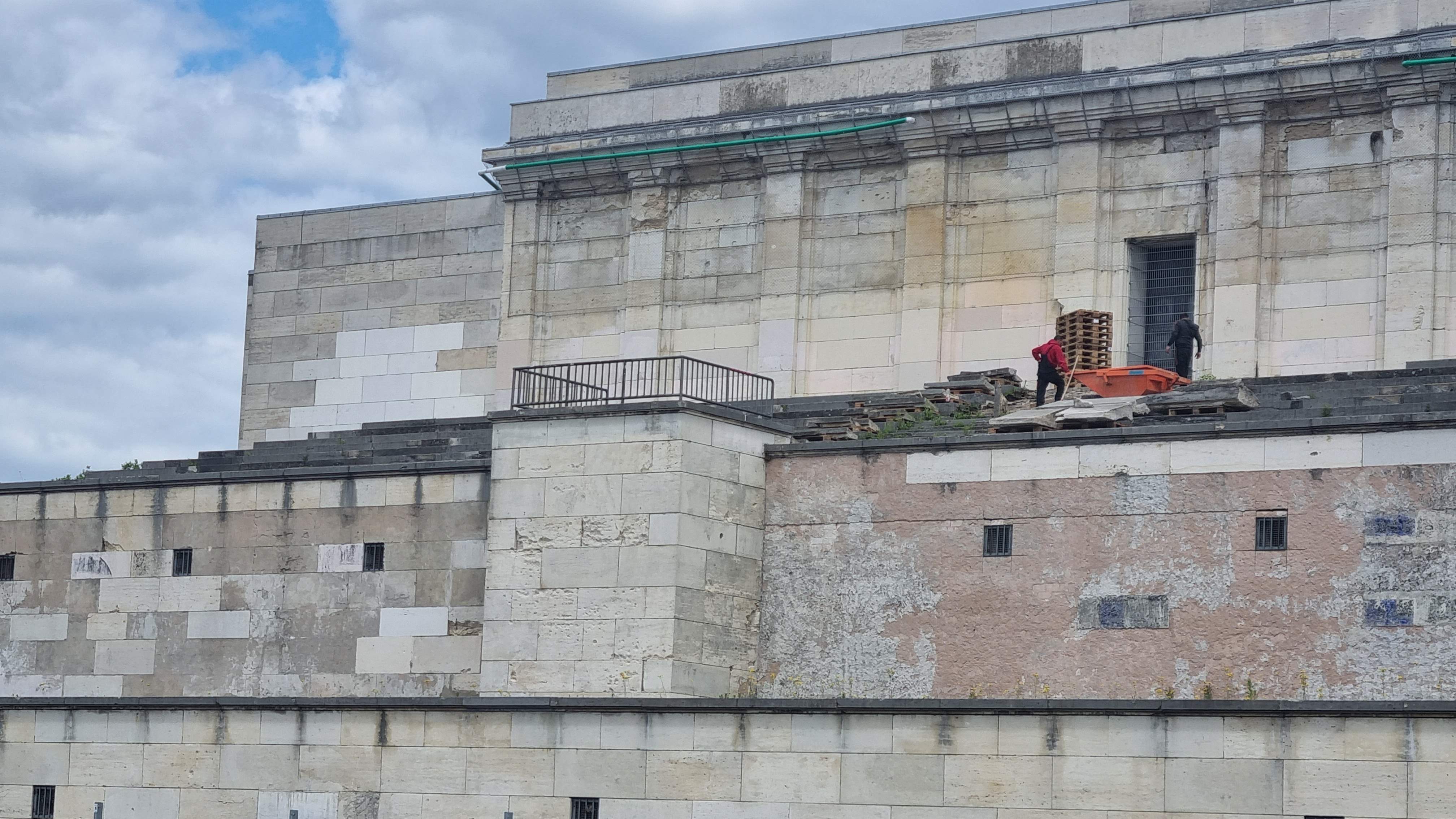 |
| Rally Ground Podium, Nuremburg, Ian Thompson, 7/5/25 |
 |
| Me at Zeppelin Fields rally Ground, Nuremburg, Ian Thompson 7/5/25 |
🏙 Nuremberg Old Town
From there, I walked back toward the Old Town (around 4.5–5 km).
I was genuinely surprised by how beautiful and well preserved it is. The Old Town is full of historic churches, streets, and medieval architecture.
Key sites include:
Frauenkirche (Church of Our Lady)
Built in 1362, famous for its Männleinlaufen clock, which performs daily at noon.
St. Sebaldus Church
One of Nuremberg’s oldest churches, dating back to the 13th century, and heavily restored after WWII.
Frauenkirche, St Sebald, Imperial Castle, and Old Town streets
 |
| Part of Imperial Castle, Nuremburg, Ian Thompson, 7/5/25 |
 |
| Part of old city walls, Nuremburg, Ian Thompson, 7/5/25 |
 |
| Me at Henkersteg, Ian Thompson, 7/5/25 |
 |
| Clock-Old Town, Nuremburg, Ian Thompson, 7/5/25 |
 |
| Old Town Street, Nuremburg, Ian Thompson, 7/5/25 |
🏰 Kaiserburg Castle
The Kaiserburg (Imperial Castle) dominates the skyline.
It was once a residence for Holy Roman Emperors and dates back to the 11th century. While impressive, I personally found the Old Town more interesting overall.
The castle does offer excellent views and a clear sense of Nuremberg’s medieval importance.
🍺 Evening
After a few hours exploring, I stopped at a restaurant called Trodelstuben, which had a slightly dark and unusual atmosphere — but excellent food.
Sausage and beer again. At this point, I’ve reached the stage where I genuinely need vegetables.
Tomorrow is another travel day, heading somewhere known more for its natural beauty than its history.
✍️ DAY EIGHT–NINE – Zell am See (Rest & History Connection)
I combined these two days as it made more sense logistically.
Day eight was mainly travel from Nuremberg to Zell am See in Austria.
For those unfamiliar, I am a follower of 2/506 during WWII, and Zell am See is significant as the location where Easy Company were billeted after the war. The US Army requisitioned the Grand Hotel, where soldiers stayed for almost ten years..
 |
| Zell Am See, Ian Thompson, 8/5/25 |
 |
| The Grand Hotel, Zell Am See, Ian Thompson, 8/5/25 |
🌄 Rest Stop in Austria
This stop was intentionally slower.
After nine days of travel, I needed a break. The area is quiet and extremely scenic, perfect for walking and clearing my head.
I completed a full walk around the lake (12–13 km), which was enough given my current fitness level.
📍 Kaprun – Final Assembly Site
I also visited nearby Kaprun by bus (free with local transport pass).
Kaprun is known for the “Final Assembly” photo of Easy Company after WWII.
 |
| Field where 'Final Assembly' photo taken 80 years later, Ian Thompson 9/5/25 |
 |
| Kaprun Castle, Ian Thompson, 9/5/25 |
 |
| 3/506 Final Assembly |
✍️ DAY TEN – Austria to Switzerland
Today was another travel day from Zell am See to Zurich via Wörgl.
I could have taken a later train, but I was worried about missing connections, so I went early.
The journey itself was one of the highlights of the trip. The scenery through Austria was spectacular — the kind of landscape that makes you seriously consider living there.
Austrian Scenary 1, Ian Thompson, 10/5/25


Austrian Scenary 3, Ian Thompson, 10/5/25

 |
| Austrian Scenery 4, Ian Thompson, 10/5/25 |
 |
| Austrian Scenery 5, Ian Thompson, 10/5/25 |
✍️ DAY ELEVEN – CERN, Geneva
The focus today was CERN, which was the main reason for visiting Geneva.
I’ve been to Geneva before and personally find it the least attractive of the major Swiss cities — expensive, crowded, and surprisingly unclean in parts compared to other Swiss cities like Zurich.
⚛ CERN Visit
CERN absolutely delivered.
The site straddles the Swiss–French border and includes both above-ground and underground facilities.
Admission is free, including guided tours, which must be booked via the CERN Wi-Fi exactly two hours before departure.
Tours are limited to around 24–25 people, so they fill quickly.
I chose the tour covering the original accelerator and the ATLAS control room.
 |
| CERN #1, Ian Thompson, 11/5/25 |
 |
| Me with Spectrometer CERN, Ian Thompson, 11/5/25 |
 |
| CERN, Ian Thompson, 11/5/25 |
 |
| Me at CERN sign, Ian Thompson, 11/5/25 |
I decided to not do any sightseeing after CERN as, to be
honest, getting very tired as I have been trying to squeeze a lot into my short
stays.
Tomorrow is my penultimate travel day when I head from
Geneva to Caen to get in some last minute WW22 history before heading back to
the UK.
✍️ DAY TWELVE–THIRTEEN – France (Caen & D-Day Coast)
How I missed travelling in France and France in general, not. I have to honestly say that things went pretty smoothly for most of my trip until I crossed the border between Switzerland and into France. Would you believe it, 30 minute delay just like that. Of all my train trips so far, the longest delay has been 10 minutes! So, thankfully I still managed to make it from Paris Gare De Lyon, which is a pretty nice and modern station across town to Gare St Lazare which is another nice station about 6 km from Gare De Lyon. The problem is that things became stressful, again, at the station as it was extremely difficult to figure out, in the maze that is Gare St Lazare, just which platform I needed to go to for my train to Caen. Well, a few minutes on my phone helped with the number but it still took a good 15 minutes of wandering around aimlessly to find the train which I did with 10 minutes to spare!
The trip to Caen was straightforward and relatively
comfortable and only took 2 hours. A quick bus trip, 25 minutes, from Caen had
me in Ouistreham by 4pm. Unfortunately, I had forgotten that a lot of places
don’t start serving food until 6pm but I managed to find one fairly decent
restaurant across from the sea front casino. For those who know D-day history,
and have watched the longest day, you’ll know this as the place where 4
Commando battled the Germans. FYI, the depiction in ‘The Longest Day’ is
incorrect, the actual casino was torn down by the Germans in 1942 leaving the
basement and foundation where they had 4 gun mounts. I guess it was just
another example of Hollywood making things up as they go.
Tuesday is/was he last actual day of the trip, I am not
counting the overnight ferry back to the UK. Given my absolutely dire state of
fitness, I decided it would be best to get some steps/kms in. My cunning plan
was to walk from my hotel, the wonderful Ibis next to the ferry port to the Churchill
ARVE display which was 6.5 km away and back taking in as many monuments as
possible and, at the end, have lunch then hit the two museums in Ouistreham. I
took off at 0900 and walked along the promenade, bit warm in the sun but it was
a beautiful day to be honest. One thing about this stretch of the D-day beaches
is that there isn’t the number of bunkers and pillboxes that you’ll find at he
other beaches. The number of pillboxes and casemates on Omaha beach, for
example, many of the Widerstandsnesters (from the original WN-60 to
WN-74) remain. However, with regards to Sword beach WN24 remains at Luc-sur-mer
and WN21 at Lion-sur-mer. There are other sites, such as WN17, that are further
in land which, without a car, I couldn’t visit. They seem to include WN26 as
part of Swords defences, but I was under the impression it falls under Juno (Happy
to be corrected).
The following pictures with captions cover most of my walk.
 |
| Centaur Dozer tank in CS markings, Ian Thompson, 13/5/25 |
 |
| Le Matelot Statue, Ian Thompson, 13/5/25 |
 |
| Me with the Churchill, Ian Thompson, 13/5/25 |
 |
| 3rd Infantry Memorial, Ian Thompson, 13/5/25 |
 |
| Piper Bill Millin Memorial, Ian Thompson 13/5/25 |
 |
| Sur Le Pas, Ian Thompson, 13/5/25 |
 |
| Momument a la Liberte de Lion, Ian Thompson 13/5/25 |
 |
| Sword Memorial, Ian Thompson 13/5/25 |
🏛 Museums
I visited:
- 4 Commando Museum (no photography allowed)
- Grand Bunker Museum
After my trek along the beach, it was time to do my
compulsory museum tours. This time is was the 4 Commando Museum and the Grand
Bunker Museum. The former is a small museum dedicated to the French Commandos
known as the Kieffer brigade. It is really small but does contain a lot of
artifacts including a significant number of weapons in very good condition.
Unfortunately, photography was not allowed so you’ll have to check out their
website (https://www.musee-4commando.fr)
or take my word for it. The later was the Grand Bunker Museum. What a fantastic
museum (https://museegrandbunker.com/en/)
with an amazing number of artifacts on display including a landing craft right
in front of the museum! This place is definitely worth the visit to Ouistreham!
 |
| Observation floor-Grand Bunker, Ian Thompson 13/5/25 |
 |
| The Grand Bunker, Ian Thompson 13/5/25 |
 |
| Landing Craft-Grand Bunker, Ian Thompson 13/5/25 |
Question for anyone who’s done a similar trip:
✈️ FINAL SUMMARY
- 13 days
- 6 countries (including Turkey)
- 6 major cities
- 2936 km by train
- 1610 km by air
- 183 km by ferry
Not too shabby.
😀


