Tuesday, 13 May 2025

What to see and do, by train, across Europe in a week part duex


✍️ DAY SIX – Travel Day (Pegasus + Munich stop)

Today was a travel day, involving another experience with a budget airline I hadn’t used before — Pegasus.

To be honest, my biggest concern was not having an entry stamp in my passport. In the end, I really shouldn’t have wasted time worrying. Security and passport control were among the smoothest I’ve experienced recently, and no one even seemed to notice the missing stamp.

💡 Traveller Tip

Yesterday’s lunch, away from the tourist areas, cost me 450 TL (around €10). A coffee and dessert at the Holiday Inn cost 380 TL, and a small can of Sprite with biscuits on the flight cost 384 TL.

The lesson is simple: eat and drink away from tourist areas and hotels whenever possible — the mark-up is significant.

Beer!!! Ian Thompson, 5/5/25

Insider Augustiner Stammer, Ian Thompson, 5/5/25

Bavarian Dinner, Ian Thompson 5/5/25


I had a fantastic Bavarian dinner of sausages, sauerkraut, pretzel, and beer at Augustiner Stammhaus, one of the oldest breweries in Munich. While the building itself is not the original, this site has been associated with brewing for centuries.


🏛 Kongresshalle (Documentation Centre)

My first stop was Kongresshalle.

The Kongresshalle (Congress Hall) in Nuremberg is one of the most striking examples of Nazi-era architecture. Built between 1935 and 1939 as part of the Nazi Party Rally Grounds, it was designed for massive party congresses but was never completed.

Inspired by the Roman Colosseum, its vast brick structure reflects the regime’s obsession with scale and permanence. Today, it houses the Documentation Centre, which presents powerful exhibitions on the history of the Nazi regime. The site remains both a warning from history and a place of reflection.


Inside Kongresshall, Nuremburg, Ian Thompson 7/5/25

Me at Kongresshall, Nuremburg, Ian Thompson, 7/5/25

🚶‍♂️ Zeppelin Field

Leaving Kongresshalle, I walked down the former processional road made up of over 60,000 stone slabs, aligned with Nuremberg Castle as intended by Albert Speer.

I then continued to the Zeppelin Field.

The Zeppelin Field was designed to hold up to 200,000 people and served as the stage for Nazi propaganda rallies led by Hitler. Its grandstand still stands today, partially preserved, and gives a stark sense of how architecture was used to project power and control.
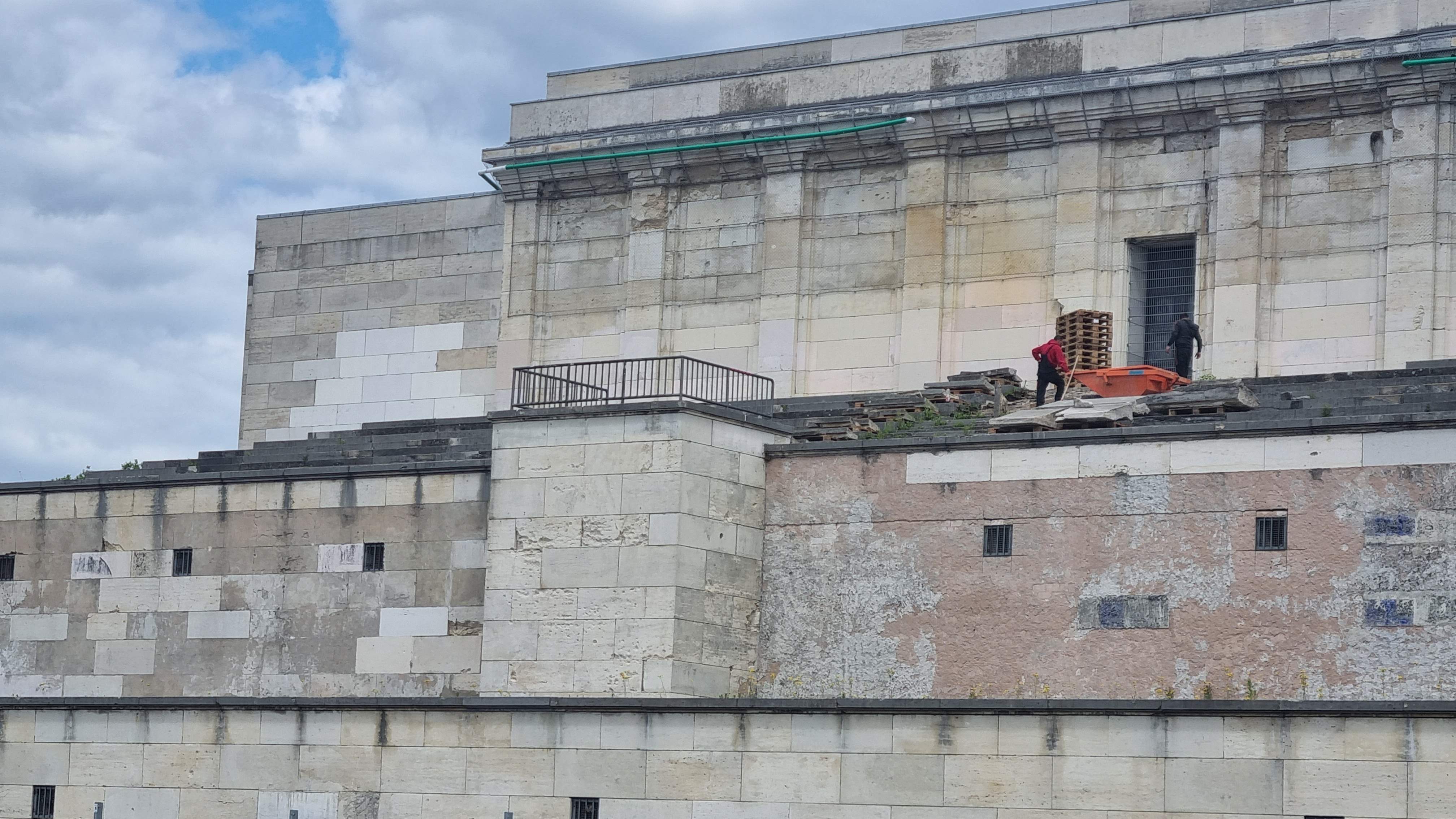
 

Rally Ground Podium, Nuremburg, Ian Thompson, 7/5/25

Me at Zeppelin Fields rally Ground, Nuremburg, Ian Thompson 7/5/25

🏙 Nuremberg Old Town

From there, I walked back toward the Old Town (around 4.5–5 km).

I was genuinely surprised by how beautiful and well preserved it is. The Old Town is full of historic churches, streets, and medieval architecture.

Key sites include:

Frauenkirche (Church of Our Lady)
Built in 1362, famous for its Männleinlaufen clock, which performs daily at noon.

St. Sebaldus Church
One of Nuremberg’s oldest churches, dating back to the 13th century, and heavily restored after WWII.

Frauenkirche, St Sebald, Imperial Castle, and Old Town streets


Part of Imperial Castle, Nuremburg, Ian Thompson,  7/5/25

Part of old city walls, Nuremburg, Ian Thompson,  7/5/25


Me at Henkersteg, Ian Thompson, 7/5/25

Clock-Old Town, Nuremburg, Ian Thompson,  7/5/25


Old Town Street, Nuremburg, Ian Thompson, 7/5/25

🏰 Kaiserburg Castle

The Kaiserburg (Imperial Castle) dominates the skyline.

It was once a residence for Holy Roman Emperors and dates back to the 11th century. While impressive, I personally found the Old Town more interesting overall.

The castle does offer excellent views and a clear sense of Nuremberg’s medieval importance.

🍺 Evening

After a few hours exploring, I stopped at a restaurant called Trodelstuben, which had a slightly dark and unusual atmosphere — but excellent food.

Sausage and beer again. At this point, I’ve reached the stage where I genuinely need vegetables.

Tomorrow is another travel day, heading somewhere known more for its natural beauty than its history.


✍️ DAY EIGHT–NINE – Zell am See (Rest & History Connection)

I combined these two days as it made more sense logistically.

Day eight was mainly travel from Nuremberg to Zell am See in Austria.

For those unfamiliar, I am a follower of 2/506 during WWII, and Zell am See is significant as the location where Easy Company were billeted after the war. The US Army requisitioned the Grand Hotel, where soldiers stayed for almost ten years..

Zell Am See, Ian Thompson, 8/5/25

The Grand Hotel, Zell Am See, Ian Thompson, 8/5/25


🌄 Rest Stop in Austria

This stop was intentionally slower.

After nine days of travel, I needed a break. The area is quiet and extremely scenic, perfect for walking and clearing my head.

I completed a full walk around the lake (12–13 km), which was enough given my current fitness level.

📍 Kaprun – Final Assembly Site

I also visited nearby Kaprun by bus (free with local transport pass).

Kaprun is known for the “Final Assembly” photo of Easy Company after WWII.


Field where 'Final Assembly' photo taken 80 years later, Ian Thompson 9/5/25

Kaprun Castle, Ian Thompson, 9/5/25

3/506 Final Assembly


✍️ DAY TEN – Austria to Switzerland

Today was another travel day from Zell am See to Zurich via Wörgl.

I could have taken a later train, but I was worried about missing connections, so I went early.

The journey itself was one of the highlights of the trip. The scenery through Austria was spectacular — the kind of landscape that makes you seriously consider living there.

Austrian Scenary 1, Ian Thompson, 10/5/25


Austrian Scenary 3, Ian Thompson, 10/5/25


Austrian Scenery 4, Ian Thompson, 10/5/25


Austrian Scenery 5, Ian Thompson, 10/5/25


✍️ DAY ELEVEN – CERN, Geneva

The focus today was CERN, which was the main reason for visiting Geneva.

I’ve been to Geneva before and personally find it the least attractive of the major Swiss cities — expensive, crowded, and surprisingly unclean in parts compared to other Swiss cities like Zurich.

⚛ CERN Visit

CERN absolutely delivered.

The site straddles the Swiss–French border and includes both above-ground and underground facilities.

Admission is free, including guided tours, which must be booked via the CERN Wi-Fi exactly two hours before departure.

Tours are limited to around 24–25 people, so they fill quickly.

I chose the tour covering the original accelerator and the ATLAS control room.


CERN #1, Ian Thompson, 11/5/25

Me with Spectrometer CERN, Ian Thompson, 11/5/25

CERN, Ian Thompson, 11/5/25

Me at CERN sign, Ian Thompson, 11/5/25

I decided to not do any sightseeing after CERN as, to be honest, getting very tired as I have been trying to squeeze a lot into my short stays.

Tomorrow is my penultimate travel day when I head from Geneva to Caen to get in some last minute WW22 history before heading back to the UK.


✍️ DAY TWELVE–THIRTEEN – France (Caen & D-Day Coast)

How I missed travelling in France and France in general, not. I have to honestly say that things went pretty smoothly for most of my trip until I crossed the border between Switzerland and into France. Would you believe it, 30 minute delay just like that. Of all my train trips so far, the longest delay has been 10 minutes! So, thankfully I still managed to make it from Paris Gare De Lyon, which is a pretty nice and modern station across town to Gare St Lazare which is another nice station about 6 km from Gare De Lyon. The problem is that things became stressful, again, at the station as it was extremely difficult to figure out, in the maze that is Gare St Lazare, just which platform I needed to go to for my train to Caen. Well, a few minutes on my phone helped with the number but it still took a good 15 minutes of wandering around aimlessly to find the train which I did with 10 minutes to spare! 

The trip to Caen was straightforward and relatively comfortable and only took 2 hours. A quick bus trip, 25 minutes, from Caen had me in Ouistreham by 4pm. Unfortunately, I had forgotten that a lot of places don’t start serving food until 6pm but I managed to find one fairly decent restaurant across from the sea front casino. For those who know D-day history, and have watched the longest day, you’ll know this as the place where 4 Commando battled the Germans. FYI, the depiction in ‘The Longest Day’ is incorrect, the actual casino was torn down by the Germans in 1942 leaving the basement and foundation where they had 4 gun mounts. I guess it was just another example of Hollywood making things up as they go.

Tuesday is/was he last actual day of the trip, I am not counting the overnight ferry back to the UK. Given my absolutely dire state of fitness, I decided it would be best to get some steps/kms in. My cunning plan was to walk from my hotel, the wonderful Ibis next to the ferry port to the Churchill ARVE display which was 6.5 km away and back taking in as many monuments as possible and, at the end, have lunch then hit the two museums in Ouistreham. I took off at 0900 and walked along the promenade, bit warm in the sun but it was a beautiful day to be honest. One thing about this stretch of the D-day beaches is that there isn’t the number of bunkers and pillboxes that you’ll find at he other beaches. The number of pillboxes and casemates on Omaha beach, for example, many of the Widerstandsnesters (from the original WN-60 to WN-74) remain. However, with regards to Sword beach WN24 remains at Luc-sur-mer and WN21 at Lion-sur-mer. There are other sites, such as WN17, that are further in land which, without a car, I couldn’t visit. They seem to include WN26 as part of Swords defences, but I was under the impression it falls under Juno (Happy to be corrected).

The following pictures with captions cover most of my walk.


Centaur Dozer tank in CS markings, Ian Thompson, 13/5/25

Le Matelot Statue, Ian Thompson, 13/5/25

Me with the Churchill, Ian Thompson, 13/5/25

3rd Infantry Memorial, Ian Thompson, 13/5/25

Piper Bill Millin Memorial, Ian Thompson 13/5/25

Sur Le Pas, Ian Thompson, 13/5/25

Momument a la Liberte de Lion, Ian Thompson 13/5/25


Sword Memorial, Ian Thompson 13/5/25

🏛 Museums

I visited:

  • 4 Commando Museum (no photography allowed)
  • Grand Bunker Museum

After my trek along the beach, it was time to do my compulsory museum tours. This time is was the 4 Commando Museum and the Grand Bunker Museum. The former is a small museum dedicated to the French Commandos known as the Kieffer brigade. It is really small but does contain a lot of artifacts including a significant number of weapons in very good condition. Unfortunately, photography was not allowed so you’ll have to check out their website (https://www.musee-4commando.fr) or take my word for it. The later was the Grand Bunker Museum. What a fantastic museum (https://museegrandbunker.com/en/) with an amazing number of artifacts on display including a landing craft right in front of the museum! This place is definitely worth the visit to Ouistreham!


Observation floor-Grand Bunker, Ian Thompson 13/5/25


The Grand Bunker, Ian Thompson 13/5/25


Landing Craft-Grand Bunker, Ian Thompson 13/5/25

Question for anyone who’s done a similar trip:

Which part would you have changed?

✈️ FINAL SUMMARY

  • 13 days
  • 6 countries (including Turkey)
  • 6 major cities
  • 2936 km by train
  • 1610 km by air
  • 183 km by ferry

Not too shabby.

😀


Monday, 5 May 2025

What to see in Europe by train...in a week!


✈️ European Trip May 2025 (Part 1: Days 1–5)

Hi all — thanks for reading my blog. This is Part 1, with at least one more part to follow once I’ve recovered and figured out the rest of the route.

✍️ Day One – London to Brussels

Took the Eurostar from St Pancras to Brussels Midi/Zuid (South), which was surprisingly simple and smooth.

The journey takes around 2 hours — not much longer than flying once you factor in airport security, transfers, and general waiting around.

My hotel, the Hilton Garden Inn, is about 1km from the station, making everything very convenient.

After arriving, I went for a walk and grabbed dinner at a local bistro — Belgian stew and frites, which was excellent.


Tomorrow will be a long day: a 09:25 train from Brussels to Munich, with a change in Cologne. Around 7.5 hours in total, but hopefully with some good scenery along the way.


        ✍️ Day 2 – Brussels to Munich via Cologne

A short walk (1.5km) brought me to Brussels station, which was packed — very similar to major UK stations, though with better food options.

I boarded the Eurostar for the first leg, passing through Liège and Aachen (Hürtgen Forest nearby — one to return for in future).

We stopped briefly in Cologne:

The Cologne Cathedral is one of Germany’s most iconic landmarks — a stunning Gothic structure that took over 600 years to complete.


The remainder of the journey was long but uneventful:

  • ~2 hours to Cologne
  • ~5.5 hours to Munich

Think London to Glasgow… and then some.

Arrived at Munich Hbf, then took the S-Bahn to Leuchtenbergring — not the most scenic area, about 3.5km from the city centre.

At least the weather is expected to be around 22–23°C tomorrow, so plenty of walking ahead.


✍️ Day 3 – Munich Old Town and History Walk

Left the hotel after breakfast and walked toward Munich Old Town (around 3km).

I detoured slightly to visit the Justizpalast and the memorial connected to the White Rose resistance group.

The White Rose were a non-violent student resistance group against the Nazi regime. Members including Hans and Sophie Scholl were executed in 1943 after distributing anti-Nazi leaflets.

Unfortunately, the building was closed, but I later found a memorial near Hofgarten and the English Garden.


St Michael’s Church

Not to be deterred by the apparent closure of a number of places I had earmarked for visiting, I headed to St. Michael’s Church – A late Renaissance Jesuit church from the 16th century, and one of Munich’s most impressive buildings.

It survived WWII bombings and contains remarkable artwork and historical tombs, including members of Bavarian royalty.


⛪ Frauenkirche

My next stop was FrauenkircheAlso known as the Cathedral of Our Dear Lady, this 15th-century Gothic church with its iconic twin domed towers is one of Munich’s most recognized landmarks. It was impressive but, in my humble opinion, not as nice as St. Michael’s. It felt a bit darker and more subdued.


🏙 Marienplatz and Old Town Center

By the time I left Frauenkirche it had started to rain, which wasn’t entirely a bad thing as it had been getting a tad warm, around 20–22°C. A quick stop into a nearby shop to purchase yet another umbrella and I was back on my way, this time to one of the main squares in the ‘Old Town’, MarienplatzThe central square in Munich’s Old Town, home to the New Town Hall (Neues Rathaus) and its famous Glockenspiel.


📸 Odeonsplatz

I headed over to OdeonsplatzA large square built in the early 19th century in a classical style, surrounded by notable buildings like the Theatine Church and Feldherrnhalle, and closely tied to both Bavarian military history and Nazi-era events.


Whilst in the area, I also took the opportunity to visit Hofgarten and Residenz MünchenHofgarten is a peaceful Italian-style Renaissance garden, while the Munich Residenz is the former royal palace of the Bavarian monarchs, showcasing opulent rooms and a vast collection of art and historical artifacts.


One thing about Munich is that the main city center is, like many other European cities, very compact, so you can squeeze a lot into a day of walking. In my best attempt to do as much squeezing as possible, I headed to the southeastern section of the ‘Old Town’ to visit the site of what was the largest synagogue in Munich prior to the HolocaustThe main synagogue was destroyed during Kristallnacht in 1938, a tragic symbol of the Nazi regime’s campaign against Jewish communities. A memorial now marks the site.


 🍺 Hofbräuhaus Lunch

By now it was approaching noon and I had been walking for 3 hours, so I figured it was time for lunch. When in Munich, at least for me, you have to visit Hofbräuhaus at least once. It is the definition of iconic German beer halls – Established in the 16th century, it's one of Munich’s oldest beer halls and is famous for its traditional Bavarian beer, hearty food, and lively atmosphere. At 12:15, it was packed with people singing and drinking. I found a table and ordered a house beer and schnitzel.

Lunch was pleasant. I met a young couple from Nuremberg—he's a footballer who will, no doubt be in the EPL, and she's about to start law studies at university. They were friendly and checked out my blog. Thanks for the chat! 😊

Leaving Hofbrauhaus with a full belly, I headed away from the ‘Old Town’ aiming to visit Englischer Garden which is a large park to the Northeast that runs along the river Iser. 

S
-Englischer Garten 3/5/25 (Ian Thompson)


Pagoda-Englischer Garten 3/5/25 (Ian Thompson)


I really only wanted to get some steps in as I have been pretty sedentary recently and need to get back into walking. The park was nice but what made the detour worthwhile was finding the Archaologische Staatssammlung, a nice little archaeological museum…and I like all things old so it was a nice find.


Archaologische Staatssammlung-Roman Statue 3/5/25 (Ian Thompson)


Archaologische Staatssammlung-Bust 3/5/25 (Ian Thompson)

Archaologische Staatssammlung-3rd/4th Century Roman Mosaic 3/5/25 (Ian Thompson)


✈️ Day 4 – Munich to Istanbul (Travel Day)

The 4th of May was a travel day. Up early for breakfast in the hotel then caught the S-Bahn to Munich Airport. I was, a bit, surprised at the price of the ticket, 14.3 Euros, but attribute that to the ‘Holiday Inn Markup’.

Pretty uneventful trip if I were to be honest. One Traveler Tip though and that is, if you are returning to Munich, use the Service Center to store any luggage that you don’t want to drag around. I decided to just take my laptop bag and one day’s change of clothes and to leave my backpack. One of the reasons is that I was flying Ajet and Pegasus both of which are budget and I had never flown on them before. I did not want to risk a huge charge when it costs 4 euros per day to leave the bag at the airport.

Comfortable and uneventful flight to Sabhia Gokcen (SAW) airport. Now, here’s the thing, there are two airports that service Istanbul, the other being IST. It is important to know that SAW is on the Asian side of the city, approximately 42 km from the center. You can take the metro, bus or taxi. As it had been a long day, I opted to take a taxi. Be prepared, it will be around £40 if they take the highway (with tolls but quicker).

⚠️ Traveller Tip

Check passport stamps. Mine wasn’t stamped on entry — only noticed later.


✍️ Day 5 – Istanbul (Hagia Sophia and Bosphorus)

🕌 Hagia Sophia

Busy day on the 5th of May as had to get out early to be back to take a call at noon….so, up early, no breakfast (could do without it anyway TBH) and out the door at 0830. The first stop, and one of the main reasons for the trip, was to Hagia Sophia Grand Mosque. Originally constructed in 537 AD under the Byzantine Emperor Justinian I, this architectural masterpiece served as the world’s largest cathedral for nearly a thousand years. With the Ottoman conquest in 1453, it was transformed into a mosque, adding elegant minarets and Islamic calligraphy to its already rich Christian mosaics. In 1935, it became a museum, symbolizing Turkey’s secular turn, and in 2020, it was reconverted into a mosque—yet it remains open to visitors of all backgrounds.

Stepping inside feels like walking through a living museum of empires. Light filters through countless windows, illuminating both glittering mosaics of Christ and Mary and vast medallions bearing Arabic script. The mix of Byzantine and Ottoman elements tells a story not just of conquest, but of cultural fusion. Whether you’re a history buff like me, an architecture lover, or a curious traveller, Hagia Sophia offers an unforgettable glimpse into the soul of Istanbul—where East meets West and past meets present.


Interior of Hagia Sofia 1, 5/5/25 (Ian Thompson)

Interior of Hagia Sofia 2, 5/5/25 (Ian Thompson)

Me with courtyard of Hagia Sofia behind me, 5/5/25 (Ian Thompson)

Exerior of Hagia Sofia, 5/5/25 (Ian Thompson)

Definitely a must for people’s bucket list!

There's always time for a coffee and a croissant in Ian's world 😃

Hagia Sophia is in an area of immense importance with the Hippodrome, also known as Al Meydani or “Plaza of Horse” and its Obelisks. Once the beating heart of Byzantine Constantinople, the Hippodrome was a grand stadium where chariot races, political drama, and imperial ceremonies unfolded. Though little remains of its original structure, today’s Sultanahmet Square still echoes its past with monuments like the Egyptian Obelisk and Serpent Column.

Serpent Obelisk, 5/5/25 (Ian Thompson)


Egyptian Obelisk, 5/5/25 (Ian Thompson)


A nice little addition to the visitt is theHagia Sofia museum. Traveller Tip: It is very expensive, 40 euros, to enter the museum and a few other sites so be forewarned. I'd also add that, having been to many museums, I felt it was way too pricey!

Hagia Sofia Museum-Holy Koran 5/5/25 (Ian Thompson)

Hagia Sofia Museum-Christian Icon 5/5/25 (Ian Thompson)

There is , also, the ‘Blue Mosque’. Standing opposite Hagia Sophia, the Blue Mosque—officially the Sultan Ahmed Mosque—is one of Istanbul’s most iconic landmarks. Completed in 1616, it stuns visitors with its elegant symmetry, cascading domes, and especially its six minarets—a rare feature that once stirred controversy. At the time, only the Grand Mosque in Mecca had six minarets, prompting concern that the sultan’s mosque was overreaching. To resolve the issue, a seventh minaret was added to Mecca’s Mosque, restoring its unique status.

Note: Photo credit to (AA) as appeared in Daily Sabbah 21-4-23

After my call, it was back on the trail of more history. This time it was in the direction of the Bosphorus, the strait which separates Western European Istanbul with Eastern Asian Istanbul. What I discovered was that much like Rome or Athens but on a much smaller scale, Istanbul has a lot of Roman ruins dotted everywhere. There is a small archaeological site, IBB Arkeoloji Park, which was closed but I managed to get a photo of. It was a bit of a shame as, despite it being small, it could have been better preserved and available.


IBB Arkeoloji Park, 5/5/25 (Ian Thompson)

🌉 Aqueduct of Valens

I, then, headed towards the Bosphorus. The first thing that I encountered was the Aqueduct of Valens. Stretching gracefully across the modern streets of Istanbul, the Aqueduct of Valens is a striking reminder of the city’s Roman past. Completed in 368 AD during the reign of Emperor Valens, this massive stone structure was part of a sophisticated water system that served Constantinople for over a millennium. Its arches once channelled fresh water into palaces, baths, and fountains—an engineering marvel that kept the imperial capital thriving.

Today, the aqueduct stands proudly above Atatürk Boulevard, seamlessly blending into the rhythm of a bustling city. Though cars now pass beneath its arches instead of water, the Aqueduct of Valens remains a powerful symbol of Istanbul’s layered history—where ancient innovation meets the present day.


Aqueduct of Valens 5/5/25 (Ian Thompson)

Passing beneath the Aqueduct, I discovered a bustling market street. Given that it was now 2pm, I figured I’d find a restaurant for some lunch. I decided upon one that had the most locals and that was the Sur Ocakbasi. The lunch was fantastic! It was tasty and inexpensive coming in around 450 Turkish Lyra (about £8.75) which was much less than any food I’d had since starting my trip!


🌊 Bosphorus

I managed, after lunch, to make it to the Bosphorus. In the end, it wasn’t to accomplish anything other than to be able to document the place where East meets West…box now ticked and it’s back towards the hotel.


View of the Bosphorus from European side 5/5/25 (Ian Thompson)

Had a bit of a detour...found another museum! There are quite a few scattered over Istanbul so, if you are into such things then you'll be happy!


By the way...these guys are everywhere. I am not a cat fan, more a dog person, but these guys are pretty cute. They even have machines where you can buy food to feed them!


That’s Days 1–5 done — a mix of cities, trains, long walks, and way too many station platforms.

I’ve been trying to see as much as possible in a short time, but I’m curious how others would approach it.

Would you do a fast-paced trip like this, or would you pick one or two countries and explore them more deeply instead?